

Drying time and temperature
Dehydrator temperatures and drying times
Food safety sets the temperature; slice thickness, humidity and tray loading set the time.
Updated:
The short answer
Choose the temperature from a recipe for the particular food, not from a universal timetable. Herbs can take 1–4 hours at 45 °C; the WetAir fruit and vegetable recipes use 60 °C, with doneness checks specific to each food. Thickness, moisture and loading change the time. This guide does not provide a drying method for meat, poultry or fish: their recipes remain unavailable pending verification of the complete safety process.
What decides the time
Slice thickness, sugar and moisture content, kitchen temperature and humidity and how densely the trays are loaded all affect the duration. A single layer with no overlap and unobstructed air openings is the main condition for an even result.
Herbs and greens: 45 °C
Dry herbs at a low temperature to preserve their aroma. At 45 °C, 1–4 hours is a starting estimate: leaves should crumble and stems snap. Cool completely, then store in tightly closed containers in a cool, dry, dark place.
Fruit, vegetables, fruit leather: 60 °C
The WetAir fruit and vegetable recipes use 60 °C; follow the preparation and doneness checks for the particular food. Check cooled fruit pieces for moist patches and vegetables for a brittle texture. Fruit leather is ready when pressing the centre leaves no indentation and the sheet lifts from the liner while still warm. A fixed time cannot account for every variety and slice thickness.
Meat and poultry: safety first
A temperature and a timer setting are not a complete jerky recipe. Safe preparation needs a verified method covering the raw material, heat treatment, drying and storage. WetAir meat and poultry recipes remain unavailable until that complete process is checked; do not reconstruct it from the abbreviated settings formerly shown here.
Fish needs its own verified method
Do not apply a meat-jerky method to fish. The species, preparation and storage conditions matter, and one temperature/time pair cannot establish safety. WetAir fish recipes remain unavailable pending verification of a complete method for the particular product.
What the dehydrator can do
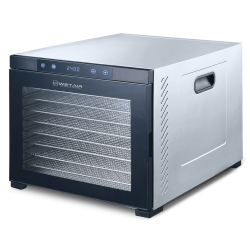
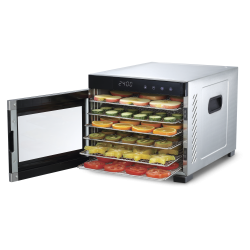
WFD-K1000S has a heater with a large-diameter fan, sets the temperature in 5 °C steps between 35 and 75 °C and has a timer up to 24 hours; the display shows END when finished. The six steel trays of WFD-K650S with a fruit-leather sheet and a fine mesh for berries suit smaller batches. Put juicy foods on the lower levels so drips do not reach the trays beneath.
Loading checklist
- Cut the food into even pieces of the same thickness.
- Spread it in a single layer without blocking the air openings.
- Use the temperature in the recipe for the particular food.
- Do not use this guide as a recipe for meat, poultry or fish.
- Check doneness after cooling and pack only cold food.
Common mistakes
- Raising the temperature to speed up herbs or fruit leather.
- Treating a temperature and drying time as a complete meat or fish safety process.
- Loading wet food densely and in several layers.
- Packing warm food — condensation will form in the jar.


WetAir manuals and support
Check the exact model requirements
If the dehydrator does not hold its temperature or the timer ends early, check the air openings and the tray loading, then contact WetAir service.
Sources and verification
Appliance settings come from the WFD-K1000S and WFD-K650S manuals. General herb-drying and storage advice follows NCHFP guidance. These sources do not validate a complete WetAir meat or fish recipe; no such method is provided here.
Frequently asked questions
Why do the recipes give no exact time for apples?
Time depends on the variety, thickness and kitchen humidity; checking doneness after cooling is more reliable than a fixed figure.
Can meat be dried at 45 °C to keep it juicy?
No. Do not improvise a meat-drying process from this guide. A complete, verified method is needed; a lower setting chosen for texture is not a safe substitute.
How should dried food be stored?
Cool fully before packing dried herbs, fruit and vegetables in airtight containers in a cool, dry, dark place. During fruit conditioning, condensation means more drying is needed if there is no spoilage. Discard mouldy food. Do not assume re-drying can make a questionable meat or fish batch safe.