

Heating season
How to choose a heater for the cold season
Prepare a convector for the season, check its position and controls, and distinguish thermostat cycling from a stop that needs attention.
Updated:
The short answer
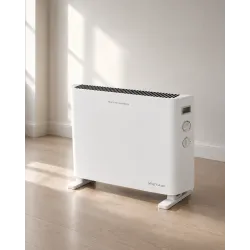
Decide the job: warming a room quickly, holding a temperature all day, or topping up the main heating. Then pick a spot with clear space and a sound earthed socket. WCH-H2000L is a slim 2000 W convector with an electronic thermostat, a schedule and wall mounting; WCH-600EWW is a simple floor-standing convector with three settings of 750/1250/2000 W and mechanical controls. Take clearances and restrictions from your own model’s manual.
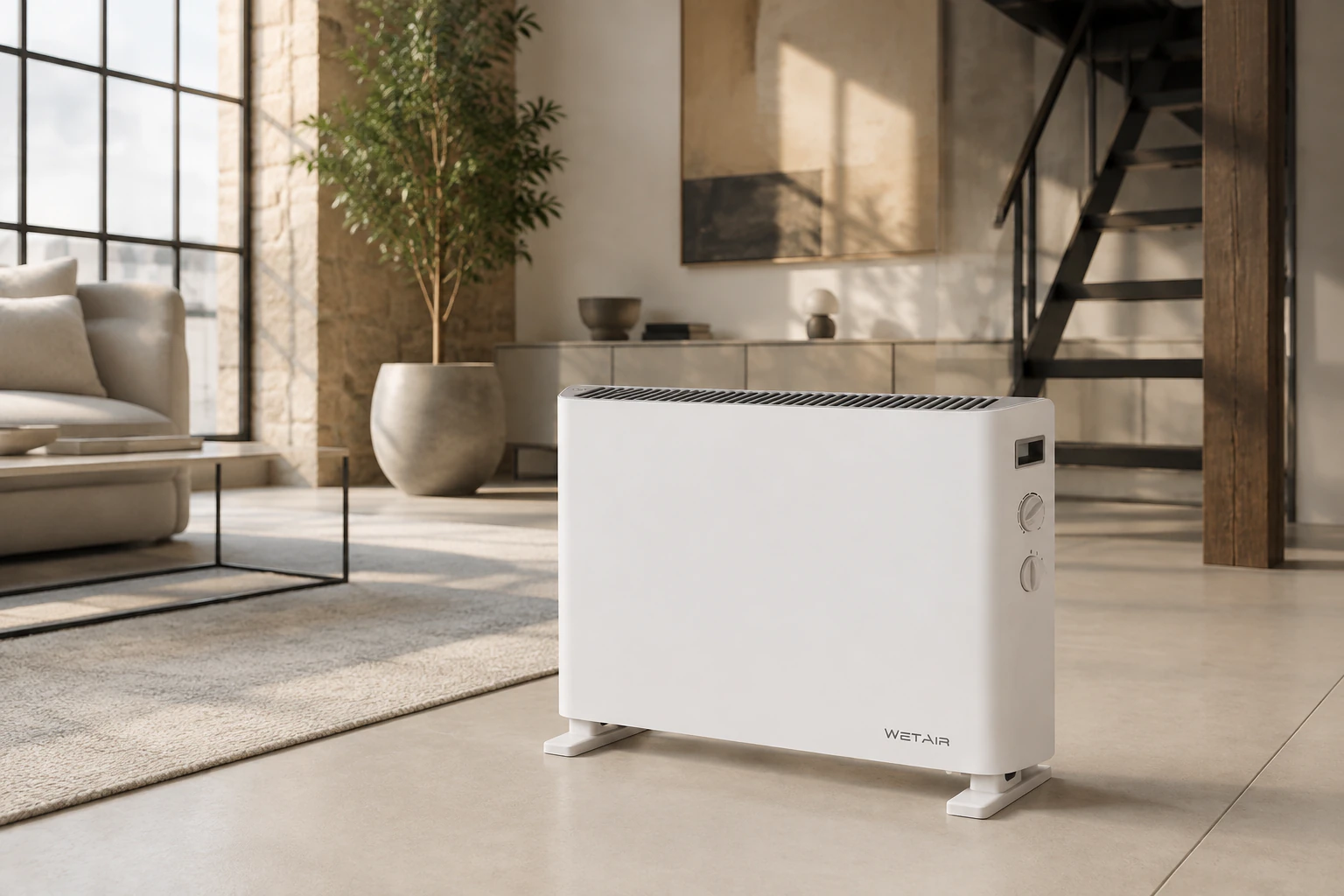
A safe place for a heater
Before switching on, check furniture clearances, the power connection and the installation location. Requirements depend on the model and how it is mounted.
- 30 cm all round (WCH-H2000L)
- Floor use: supplied feet on a stable, level surface, with at least 30 cm of clear space around the unit. Wall-mounting: lower edge at least 30 cm above the floor. Do not raise a floor-standing heater on improvised supports.
- 1 m to textiles (WCH-600EWW)
- Furniture, curtains, bedding and other textiles no closer than 1 m.
- Socket
- Sound, earthed, no extension lead. WCH-H2000L must not stand directly below a socket.
- Nothing on top
- Never cover the heater or dry towels or clothes on it.
Bathroom rules differ: WCH-600EWW is not allowed there; WCH-H2000L only within its manual and wiring rules.
Which model fits your needs
A quick choice between the two models in this guide.
You want a weekly schedule and accurate temperature
WCH-H2000L: electronic 5–35 °C thermostat, programmes P1–P3, off-timer up to 9 hours.
You want something simple with no set-up
WCH-600EWW: three settings of 750/1250/2000 W and a mechanical thermostat.
You want to hang it on the wall
WCH-H2000L can stand on the floor or hang on a wall bracket.
The room is often unused in winter
WCH-H2000L has frost protection that holds 7 °C.
You need a heater for a bathroom
WCH-600EWW is not suitable. For WCH-H2000L the manual allows zone 2 under wiring rules — an electrician decides.
This compares features and installation. How to estimate how much heat a room needs is covered in the heater sizing guide.
What the heat is for
The job decides the format and controls. To warm a room quickly in the morning you need enough power and a thermostat. For steady warmth through the day, accurate temperature setting and a schedule matter more. If the heater only tops up the main heating, a lower setting is often enough. Note how many hours and on which days it will run: you will need this both to choose and to estimate running costs.
What the two models do
WCH-H2000L has electronic controls, a 5–35 °C thermostat, Comfort (2000 W) and ECO (1000 W) modes, an off-timer up to 9 hours, weekly programmes, an open-window function and 7 °C frost protection. The 6.5 cm body can stand on the floor or hang on a bracket. WCH-600EWW is mechanical: three settings of 750, 1250 and 2000 W and a thermostat that stops heating once the set temperature is reached. Both have overheat protection. Do not confuse the setpoint with the current temperature: the thermostat controls heating using the temperature near the appliance. A timer or schedule can affect starting. Check your model’s mode and schedule before changing settings; do not add an external timer where the manual prohibits it.
Placement and clearances
For floor-standing use, place WCH-H2000L on its supplied feet on a stable, level floor, leaving at least 30 cm of clear space around it for airflow. For wall-mounting, the lower edge must be at least 30 cm above the floor; follow the other gaps in the mounting diagram too. Do not place it directly below a socket. For WCH-600EWW, keep furniture, curtains, bedding and other textiles at least 1 m away; it must not be used in bathrooms or other damp rooms. Never cover any heater or dry clothes on it. The WCH-H2000L manual allows bathroom zone 2 under national wiring rules, provided nobody in the bath or shower can reach the controls; agree such an installation with an electrician.
Socket and power supply
WCH-H2000L is Class I, so it needs an earthed socket. Do not run several high-power appliances from one socket; for WCH-600EWW the manual advises against extension leads because the cable can overheat. The plug may get slightly warm, which is normal, but if it is hot, switch off and have the socket checked by an electrician. WCH-H heaters must not be powered through an external timer or a circuit that switches on and off regularly.
Store for summer and prepare for heating
For WCH-H2000L and WCH-600EWW, begin care only after switching off, unplugging and allowing the heater to cool completely. Cleaning does not require opening the housing.
Finish the season
Wipe the exterior with a soft damp cloth without aggressive cleaners. The WCH-H2000L manual also allows gentle vacuuming over the grilles; store it in a dry, ventilated place in its packaging or covered with a soft cloth. Cover only a cool, unplugged heater in storage.
Inspect and install
Remove all packaging and covers, inspect the housing, cable and plug, and remove dust. Check feet or mounts and the model-specific clearances above. Do not switch on a damaged or unstable heater.
Check the controls
Connect as described in the power-supply section and supervise the first heating cycle. After disconnection, check the clock, day and programme on WCH-H2000L; check the power setting and thermostat on WCH-600EWW. A burning smell, damage or repeated safety cut-outs call for stopping, not further trials.
The convector switches off: checks without repairs
Heating that pauses after reaching the setpoint can be normal thermostat operation. Repeated stops while cold, a burning smell, a damaged plug or unusual behaviour need a different response. Do not open the housing or bypass protection.
| Observation | Check | Next action |
|---|---|---|
| The room is warm and heating cycles | Setpoint, mode and timer | Observe temperature maintenance; not every pause is a fault |
| Heating does not start | Power, user-accessible settings and schedule | Consult the exact model’s manual; do not dismantle it |
| Repeated stops, a smell or damage | Unobstructed vents and correct installation | Stop using it, unplug if safe and contact service |
A separate socket is not proof of a separate circuit
A heater in one socket and a kettle in another may load the same wiring. Do not infer safe capacity from the number of sockets or an extension lead’s label. An electrician should establish circuit allocation and check protection; do not open a socket or electrical panel to investigate.
Warning signs that mean stop
Do not test a suspect plug by touching it. Unusually strong heating, a smell, darkening, deformation, crackling or a plug that is not held securely require you to stop using the connection.
| Warning sign | Safe response |
|---|---|
| Smell, darkening or deformation | Stop use and arrange an electrician’s inspection |
| Loose contact or crackling | Do not hold or wedge the plug in place |
| Protection trips | Do not repeatedly reset it to continue heating |
What to tell the electrician
Report the heater model and power setting, other appliances running at the time and the signs observed. Do not reproduce the fault with repeated starts. If heat, damage or moisture makes unplugging unsafe, do not touch the connection; isolate power only by a safely accessible means.
A setpoint is not a room-thermometer reading
When setting temperature on the WCH-H1000L / H1500L / H2000L series, the display shows the target. Do not treat it as a measurement to compare directly with a thermometer across the room. To assess comfort, place the thermometer in the occupied area, away from direct sunlight, draughts and the hot-air stream, and allow conditions to settle.
A heating pause can be normal
The thermostat cycles heating. If the room is comfortable, a pause alone does not indicate a fault. If it feels cold, first check the selected mode, settings and open windows. Stop using the appliance and contact service if there is a burning smell, damage or repeated protective shutdown.
7 °C frost protection: the limits of the setting
For WCH-H1000L, WCH-H1500L and WCH-H2000L, the manual specifies a fixed 7 °C frost-protection target; it cannot be adjusted in that mode. The thermostat controls heating using the temperature sensed by the appliance. This is not a measurement of every pipe or a guarantee that the entire home will remain frost-free.
Identify cold areas
Before freezing weather, note pipe routes and areas separated from the heated room. Do not assign the convector’s displayed temperature to those areas.
Plan for frost and absence
Discuss plumbing protection and prolonged outages with a professional. Do not leave a portable heater unattended as a way to protect the whole home.
| Area / condition | Why it needs separate attention | What to prepare |
|---|---|---|
| Near the convector | Conditions can differ from remote areas | A separate thermometer check following its instructions |
| Pipes in a cabinet or at an outside wall | Cold, poorly insulated areas are more vulnerable | A professional review of pipe location and insulation |
| Room behind a closed door | Warm-air exchange is restricted | Separate observation in that room |
| Power outage | The convector cannot heat without power | A plumbing contingency plan with the person responsible for the building |
Does an electric heater “burn oxygen” or water?
An electric resistance element converts electricity to heat without burning fuel, so this process does not consume room oxygen. Heating can lower relative humidity without removing water. The room still needs ventilation: choose how and when to air it with regard to weather and outdoor air quality.
Before choosing
- Decide the job: quick warm-up, steady heat or topping up the heating.
- WCH-H2000L: supplied feet and 30 cm of space around it for floor use; for wall-mounting, also leave at least 30 cm above the floor. WCH-600EWW: keep textiles 1 m away.
- Check for an earthed socket and do not plan on an extension lead.
- Decide whether you need a schedule and timer or simple mechanical settings.
- For a bathroom, only a model whose manual allows it, installed with an electrician.
- Before the season, inspect the cable and feet without opening the housing.
- Record the mode, setpoint and circumstances of an unusual stop for service.
- Connect directly, without an extension lead or multi-socket adaptor.
- Consider other high-power appliances on a possibly shared circuit.
- Stop use when warning signs appear, pending inspection.
- Distinguish the displayed target from measured room temperature.
Common mistakes
- Placing the heater below a socket or against curtains and beds.
- Drying towels or clothes on the heater.
- Running a high-power heater from an extension lead with other appliances.
- Using WCH-600EWW in a bathroom or other damp room.
- Assuming the next socket is on another circuit.
- Repeatedly resetting protection or repairing contacts yourself.
- Judging the entire room using a thermometer directly above the convector.
Did you find your answer?
If this solved your question, you can bookmark this guide.
Try your question or model in the helper. If the guidance did not help, contact support.
WetAir manuals and support
Check the exact model requirements
If you are unsure about the wiring, wall mounting or a bathroom installation, contact a qualified electrician and follow the model’s manual.
Models to compare
Sources and review
Power, modes, clearances, bathroom restrictions and power-supply requirements come from the WetAir WCH-H1000L/H1500L/H2000L and WCH-600EWW/WCH-600EWB manuals. The comparison covers features and installation, not how quickly a particular room warms up.
Frequently asked questions
How do I compare heaters of different types?
By the job: power and settings, thermostat, schedule, how it is installed and the manual’s restrictions. The type alone does not guarantee a result in a particular room.
How close can a heater stand to furniture?
Leave at least 30 cm of space around WCH-H2000L. For floor use it stands on its supplied feet; the 30 cm gap above the floor applies to wall-mounting. Keep WCH-600EWW at least 1 m from furniture, curtains and textiles.
Can WCH-600EWW go in a bathroom?
No. Its manual prohibits bathrooms and other damp rooms. For a bathroom, consider only a model whose manual explicitly allows it, installed with an electrician.
Why a thermostat?
It stops heating once the room reaches the set temperature and restarts when it drops. WCH-H2000L has an electronic 5–35 °C thermostat; WCH-600EWW a mechanical one.
Does every pause in heating mean a fault?
No: the thermostat may pause heating when the setpoint is reached. Do not dismiss repeated unexplained stops, smells or damage as thermostat cycling: stop using the appliance and contact service.
Is moving the plug enough?
No. It neither establishes appliance or wiring safety nor guarantees another circuit.
Does any warmth mean a fault?
Not necessarily. However, strong or unusual heating and other warning signs must not be ignored; do not invent a touch-based safety threshold.
Why does the convector alternate between heating and pauses?
This can be normal thermostat control. Check comfort and the selected mode; repeated protective shutdowns or a burning smell need service assessment.