

Home food dehydration
How to dry vegetables, fruit, herbs and meat at home
Reliable drying starts with uniform preparation, clear airflow, a product-specific doneness check and a separate safety plan for foods of animal origin — not with a promise from the timer.
Reviewed:
The short answer
Use a tested method for the exact food. Prepare clean, evenly cut pieces and load one layer without overlap. Follow that method's temperature and check several cooled samples; drying time varies with the batch. The meat and fish discussion below explains safety limits, not a complete recipe. WetAir meat, poultry and fish recipes remain unavailable pending verification of the full process, including storage.
Start with the food and a tested process
Record what you are drying, its intended use and the tested instructions for the batch. Apple slices, herbs, blanched vegetables, fruit leather and jerky need different preparation and doneness checks. A general online chart cannot account for variety, ripeness, water content, previous heating or slice thickness. Select sound produce with no mould, decay or doubtful odour. Wash hands, worktops, tools and plant foods, removing damaged parts. Check whether the exact vegetable method requires blanching. Never transfer a setting merely because two foods look alike. If the instructions omit your ingredient, cut or intended storage, find a suitable process before loading the dehydrator.
Make thickness and surface moisture consistent
Uniform thickness helps pieces lose moisture at a similar rate. Use a knife, mandoline or slicer to make even cuts; thin edges overdry while a thick centre stays moist. Give round produce a stable face and keep fingers clear of the blade. After washing or blanching, drain and blot gently: surface drops delay drying, while squeezing damages the food. Separate noticeably different sizes or ripeness levels. If food darkens, use only the pretreatment in a tested recipe. Acid or salt may alter flavour and colour, but neither proves safety. Record thickness and preparation so the next batch can be compared with evidence rather than memory.
Load trays without overlap and preserve airflow
Arrange pieces in one layer without overlap. Do not cover all perforations or improvise a liner that blocks airflow or is unsuitable for food contact. Use the designated solid sheet for fruit leather and compatible fine mesh for small pieces. Keep vents and the manual's external clearances open. Never place raw meat above ready-to-eat fruit or herbs, where drips could transfer. Adding wet food to a nearly finished batch raises moisture inside the chamber. Rotate trays only when the exact manual requires it or samples show a consistent difference; work quickly with clean hands. Otherwise avoid repeated opening, which changes drying conditions.
Select temperature without turning the timer into a promise
Set temperature from a tested method for that food and stay within the exact appliance manual. Lower is not automatically gentler: slow drying can leave food warm and damp, while excessive heat can harden the outside before the centre dries. Time varies with thickness, initial moisture, tray load, circulation, room temperature and humidity. Take the first inspection point from a reliable recipe, then judge several samples from different positions. Do not raise the setting at random. If a cut surface shows moisture, continue drying and review the loading. Record ingredient, preparation, thickness, setting, sample positions and result; that evidence is more useful than a universal number of hours.
Test signs of doneness after a sample has cooled
A hot piece feels softer and wetter than it will when cool, so assess several cooled samples from different trays. Dried fruit should be leathery yet pliable. Vegetables for storage should be brittle or crisp; ready herbs have leaves that crumble and stems that break. In finished fruit leather, pressing the centre leaves no indentation; while warm, the sheet should lift from the approved liner. Use each sign only with tested instructions for that food. Examine a thick sample's centre, not just its dry edge. A jerky bend test describes texture only after pathogen-control heating and cannot prove that heating occurred. If samples differ, remove finished pieces and continue drying the rest rather than packaging an averaged result.
Separate safety for meat, poultry, ground meat, game, fish and jerky
Keep raw meat, poultry, ground meat and game refrigerated while thawing or marinating, and do not reuse their utensils for finished food until properly washed. For home jerky, USDA FSIS recommends a separate heat stage before dehydration, verified with a food thermometer: meat, including beef, pork, lamb, game and ground red meat, must reach 71 °C / 160 °F; poultry and ground poultry must reach 74 °C / 165 °F. Only then is dehydrator air maintained at 54–60 °C / 130–140 °F for the drying stage. These are different measurements. The selected setting and appliance display are not the internal food temperature; use a food thermometer. Colour is not proof of safety, and marinade, salt, smoke flavour, freezing or a bend test cannot replace the heat stage. Ground forms need a tested forming process rather than an assumption borrowed from whole strips. Fish needs a current species-specific official method covering preparation, drying, packaging and storage. This general guide does not provide a fish process. Without separate validation, do not treat it as shelf-stable and do not improvise with whole fish or reduced-oxygen packaging.
Cool, equalise fruit moisture and pack for storage
Cool dried food fully on a clean, dry surface before packing; avoid leaving it exposed long enough to absorb moisture again. For dried fruit, equalise moisture between pieces by packing loosely in clean transparent containers for 7–10 days. Close them, shake daily and check for condensation; if it appears, re-dry fruit only if there is no spoilage. Discard mouldy food. Brittle vegetables do not need this fruit-conditioning step. Pack small portions in clean, dry containers that keep out moisture and pests, and label the food and date. Sealing or vacuum packing cannot correct inadequate drying. NCHFP's two-week room-temperature limit for jerky applies only after a complete tested process and proper drying; longer keeping needs refrigeration or freezing. It does not validate the unavailable WetAir animal-protein recipes.
Match the batch to the appliance and verify its manual
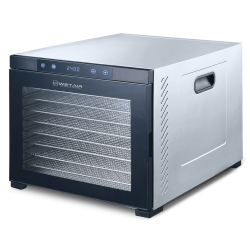
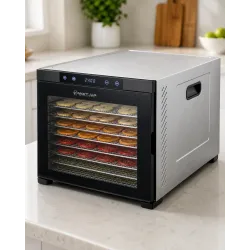
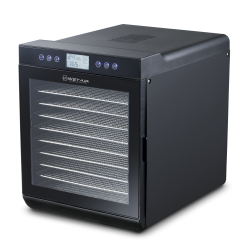
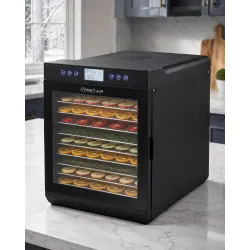
Tray capacity organises a batch but does not change its food-specific process. WFD-K1000S — 10 trays, 35–75 °C, a timer up to 24 hours in steps of 30 minutes. These are appliance facts, not a programme for every ingredient. WFD-K700BSS — 10 perforated sections; before first use, its manual requires the empty interior and sections to dry for 30 minutes with no food loaded. This is one-off preparation of a new appliance, not a routine pre-load or food pathogen-control step. Follow each exact manual for cleaning, loading, positioning and electrical safety. Keep pieces in one layer. When a food-core endpoint is required, use a separate validated heat stage and food thermometer: the dehydrator heater, range and display do not prove every piece reached that endpoint.
A repeatable sequence for every batch
- Choose tested instructions for the exact food, cut and intended storage.
- Prepare sound clean food to uniform thickness and record any pretreatment.
- Load one layer without overlap and leave every required airflow path clear.
- For foods of animal origin, separate thermometer-verified safety heating from the dehydrator setting.
- Test several cooled samples from different positions against product-specific signs of doneness.
- Cool fully; equalise moisture in dried fruit, then pack dry food in small, labelled portions.
Mistakes that compromise the result or its safety
- Mixing markedly different thicknesses and ending the whole batch when the thinnest piece is ready.
- Blocking trays with food or an improvised liner and deciding doneness only from the timer.
- Treating marinade, salt, colour, odour or bend as a substitute for a food thermometer when making jerky.
- Packing warm or questionably damp food and expecting an airtight container to correct the process.
WetAir manuals and support
Check the exact model requirements
Use the food-dehydrator category to compare tray formats, then open the exact manual from the WFD-K1000S or WFD-K700BSS product page. Use a separate tested method for food temperature, preparation and storage. WetAir service can help with appliance operation, but it is not a substitute for a food-safety process authority.
Official sources and the limits of this guide
Current USDA FSIS and University of Georgia National Center for Home Food Preservation material supports the jerky boundaries. Separate NCHFP sources support the stated fruit, herb and fruit-leather doneness signs, plus cooling, fruit conditioning and packaging. Each source applies only to its named food and stage; none establishes a universal duration, batch yield or home fish process. WFD-K1000S and WFD-K700BSS figures come only from the matching manual and describe the appliance, not temperature inside food.
Frequently asked questions
Why is there no single drying time for apples, vegetables and jerky?
Thickness, variety or species, initial moisture, pretreatment, tray load, room temperature and humidity all change the process. Take the first inspection point from tested instructions, then assess several cooled samples from different positions. A timer schedules inspection; it does not establish doneness.
Should I rotate trays during drying?
Only when the exact model manual calls for it or control samples show a consistent difference. Do not open the chamber unnecessarily, and never exchange positions between raw meat and ready-to-eat food. First check that vents are clear and no pieces overlap.
Is the meat mode on a dehydrator enough to make jerky?
No. USDA FSIS separates measured heating inside the food before dehydration from the later drying-air temperature. Use a food thermometer and the process for the relevant meat or poultry. A mode label and display do not measure the centre of each piece.
What should I do if condensation appears after packing?
For fruit being conditioned, return the batch to the dehydrator and check doneness again; discard mouldy food. For animal foods, refrigeration, re-drying or vacuum packaging cannot correct uncertain heating or incomplete drying. Discard the doubtful batch unless an official method for that exact food and process explicitly provides a corrective action.