

DEHUMIDIFIERS • BUYING GUIDE
Choose a dehumidifier for your room
Look beyond floor area: understand litres per day, compare three models and plan how you will empty or drain the collected water.
Updated:
The short answer
Start with room size, temperature and the source of dampness. Then compare extraction capacity, tank size and drainage. A litres-per-day rating does not promise that exact amount of water in your home.
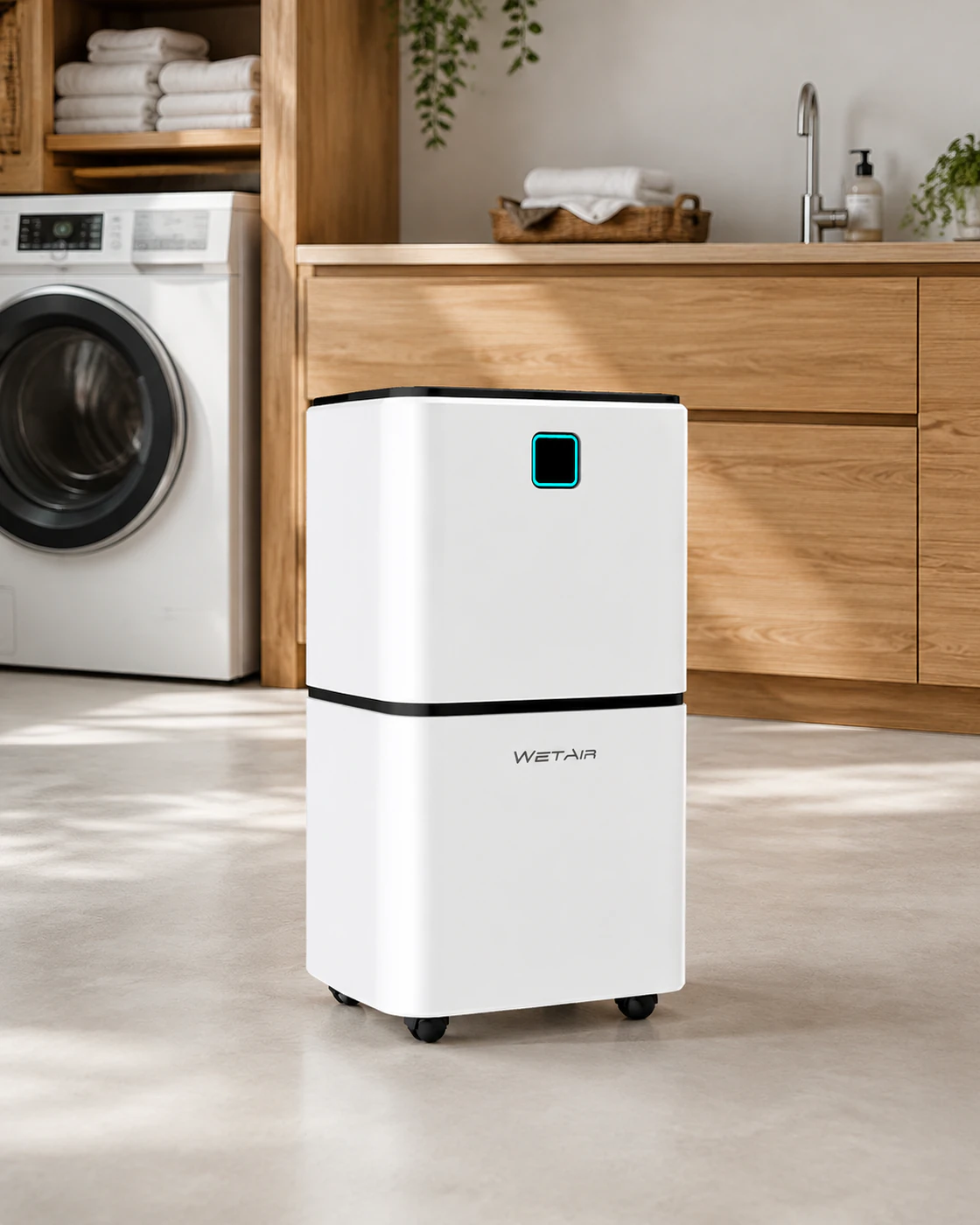
From measurement to selection
-
Measure
Record floor area, temperature and hygrometer readings.
-
Compare
Check the specific model’s capacity and operating range.
-
Plan drainage
Use the removable tank or a suitable continuous drain.
This sequence helps you gather the right information; it is not an engineering calculation for complex spaces.
Where to put a dehumidifier and where the water goes
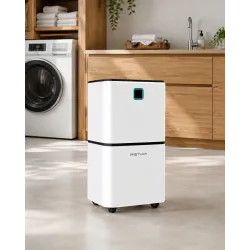
Leave 40 cm behind and at the sides, and 10 cm in front. Minimum space above the unit varies by model: WAD-B25L — 20 cm, WAD-F12L — 30 cm, WAD-A10L — 40 cm. Do not place the unit under a low shelf.
- 40 cm behind and at the sides
- Keep furniture and objects at least 40 cm from the back and sides: that is where air enters and leaves.
- 10 cm in front
- Leave at least 10 cm clear in front. Never cover the unit or dry wet clothes on it.
- Removable tank
- Handy when there is no drain nearby. How often you empty it depends on how much water is actually collected.
- Continuous drain
- Run the hose downwards to the drain with no rises or kinks; check the connection for leaks before long unattended use.
Use the dehumidifier indoors only, within the operating temperature range in its manual.
Why room size is only a starting point
Two rooms with the same floor area can have very different moisture loads. One may be used to dry laundry; another may have a leak. Record morning and evening hygrometer readings, check ventilation and inspect windows and walls. A dehumidifier collects moisture from the air; it does not repair a leak.
What litres per day actually means
The stated 10, 12 or 25 litres per day describes performance under test conditions. A cooler or already drier room can produce less collected water. There is no universal conversion from square metres to litres: temperature, incoming moisture and air exchange all affect the result.
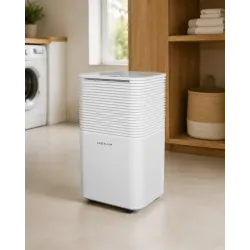
WAD-A10L: up to 10 litres per day
The WAD-A10L manual gives an area guide of up to 20 m², extraction up to 10 litres per day and a 2-litre tank. Its operating temperature is 5–35 °C. Consider it for a small room whose conditions meet the manual; how often you empty it depends on actual water collection.
WAD-F12L: up to 12 litres per day
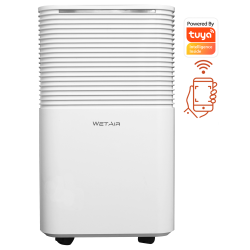
WAD-F12L has a 2-litre tank, a stated capacity of up to 12 litres per day and an area guide of up to 25 m². Its operating range is 5–35 °C. DRY mode runs continuously without a selectable humidity target; use the appropriate humidity-controlled mode to maintain a chosen setting.
WAD-B25L: a larger 6.5-litre tank
WAD-B25L is rated up to 25 litres per day, with an area guide of up to 40 m² and an operating range of 5–38 °C. Its 6.5-litre tank holds more than the two compact models. Tank volume and extraction rate are different specifications: a larger tank alone does not make drying faster.
Tank or continuous drainage?
A tank is convenient where no drain is nearby. For longer operation, consider continuous drainage following the model’s manual. Check connections and the water path before use: kinks or uphill sections must not obstruct gravity drainage. Test a new connection for leaks before relying on it.
Check these details before buying
| Factor | What to record | Why it matters |
|---|---|---|
| Floor area | Room dimensions and connected spaces | An area guide does not mean one unit can dry every room through closed doors. |
| Temperature | Typical and lowest room temperatures | Check the operating range; performance changes in cooler conditions. |
| Humidity | Several hygrometer readings | A single reading after a shower does not describe everyday conditions. |
| Moisture source | Laundry, condensation, ventilation or leaks | Repair a fault first if it is causing water ingress. |
| Drainage | Tank access and a suitable drain location | Plan how you will maintain the unit. |
| Position | Level floor and unobstructed openings | Follow the clearances specified for your particular model. |
Your selection checklist
- Measure floor area, temperature and humidity.
- Identify where moisture comes from.
- Compare the model, tank and drainage options.
- Check the proposed position against the manual.
Common misunderstandings
- Litres per day is neither tank volume nor a guaranteed result at home.
- Dehumidifying does not replace leak repairs or suitable ventilation.
- Do not position the unit against furniture or block its grilles.
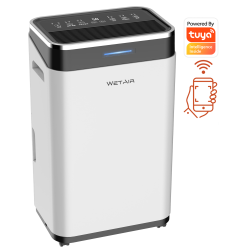
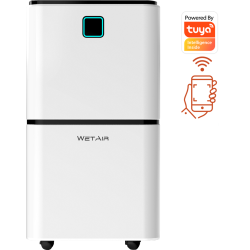
WetAir manuals and support
Check the exact model requirements
Need help choosing, installing or maintaining a model? Tell WetAir support the model, conditions of use and your question.
Sources and manuals
Model specifications and care instructions were checked against the manuals below. Check the label on your appliance for the exact version.
Frequently asked questions
Can I choose by floor area alone?
Floor area is a starting point. You also need temperature, measured humidity and an understanding of the moisture source.
Why does the tank fill more slowly than the daily rating suggests?
Collection depends on room conditions. Lower temperature or humidity can reduce the amount of water collected.
Can I control it from a phone?
For compatible Wi-Fi models, use the linked Tuya guide below. It lists model-specific pairing buttons.