

Heating capacity
How to match heater output to room size
Two 15 m² rooms can need very different amounts of heat. Here is how to assess your room quickly and check the choice in practice.
Updated:
The short answer
Note the floor area and ceiling height, then mark what takes heat away: external walls, large windows, draughts, doors to a cold hallway. Decide whether the heater will top up existing heating or heat the room on its own. Compare that with the model’s purpose and power settings. There is no universal “watts per square metre” rule, so check the result with a thermometer on a cold day after you buy.
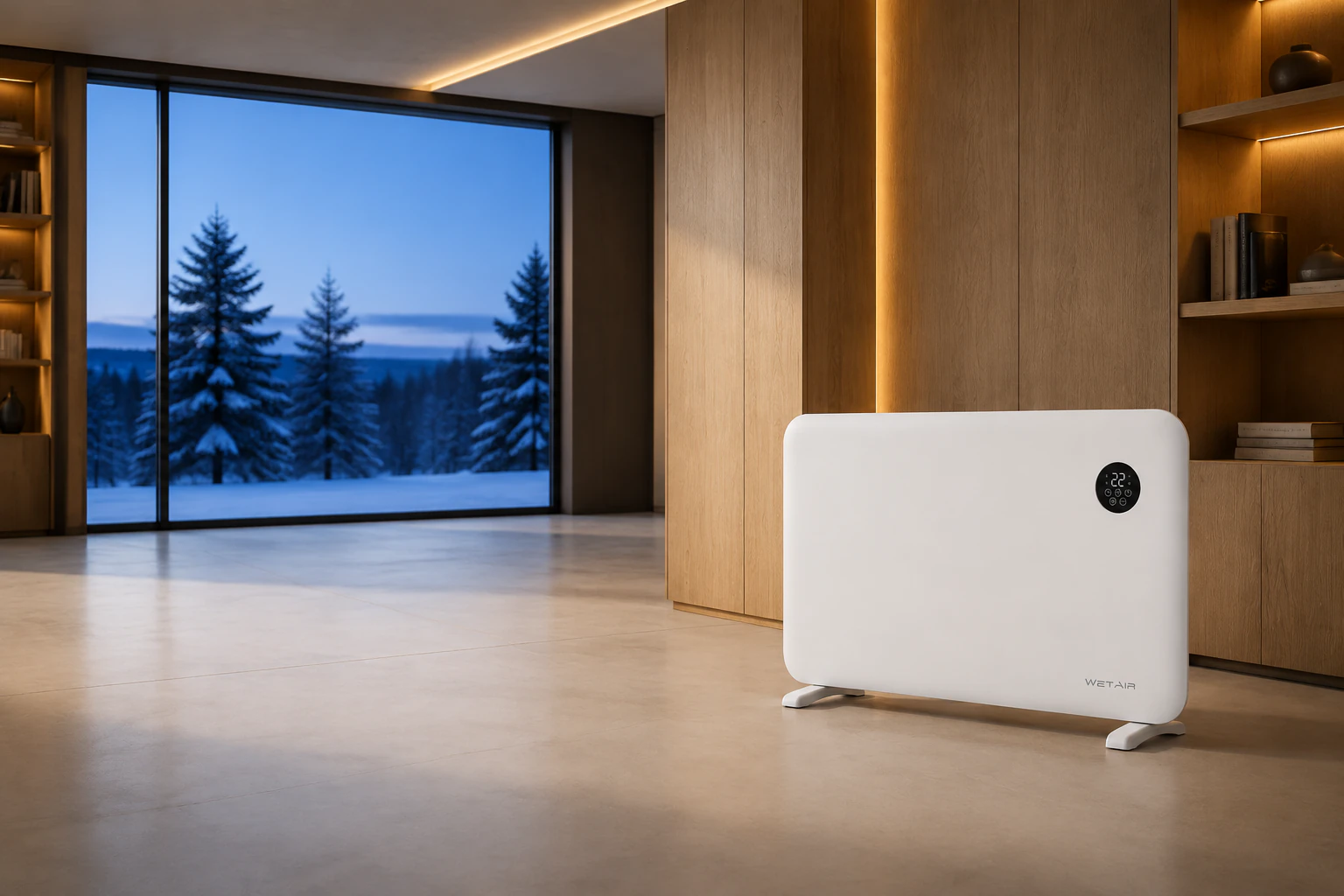
What decides how much heat a room needs
Floor area alone is not enough. Before choosing a heater, consider ceiling height, insulation, windows and existing heating.
- Ceiling height
- You heat the whole volume of air, not just the floor.
- External walls
- A corner room with two external walls loses more heat.
- Windows
- Large or old glazing loses heat quickly; heavy curtains at night help.
- Doors and draughts
- Gaps and doors to a cold hallway draw warm air away.
- Existing heating
- If a radiator is working, the heater only needs to add some warmth.
This checklist helps assess the room, but does not calculate the required wattage. A precise heat-loss calculation for a complex room is a job for a professional.
Measure the room, not just the floor
Floor area tells you how much floor there is, but you heat the whole volume of air. Note length, width and ceiling height: a room with a high ceiling or a mezzanine needs more heat than one of the same area with a standard ceiling. Include connected spaces — an open arch to the hall, open stairs, an open-plan kitchen — because heat will flow there too.
Find where the heat goes
A room loses most heat through external walls, windows and gaps. A corner room has two external walls, large or old glazing loses heat faster, and a draught at floor level feels cold even when the air temperature is fine. Mark these on a sketch; small fixes such as draught strips and heavy curtains at night are worth doing before choosing the power.
Main or supplementary heat
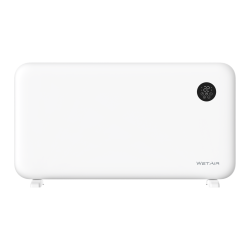
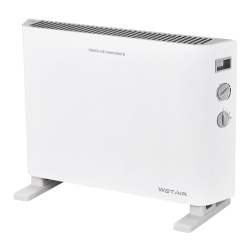
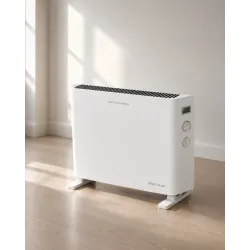
If central heating is running, the heater only adds a few degrees on cold days, and a lower setting is often enough. If it is the only source of heat — a holiday cottage or an unheated room — the load is much higher and the heater will run longer. WCH-600EWW has settings of 750, 1250 and 2000 W; WCH-H2000L has Comfort 2000 W and ECO 1000 W modes.
Check your choice in practice
After installation, set your usual temperature on the thermostat and watch it on a cold day. If the heater reaches the temperature and switches off, there is enough headroom. If it runs flat out for hours without reaching the set point, look for draughts, open doors or other heat losses, or consider an extra heat source. Never make up for too little power with extension leads and several heaters on one socket.
Room sizing checklist
- Note floor area, ceiling height and connected spaces.
- Mark external walls, large windows and draughts.
- Decide the role: topping up heating or the only heat source.
- Compare the model’s power settings and purpose.
- Check the result with a thermometer on a cold day.
Common mistakes
- Counting floor area and ignoring a high ceiling.
- Treating supplementary heating as if it were the only heating.
- Treating a “watts per metre” rule as a guaranteed result.
- Plugging a second heater into the same socket instead of fixing a draught.
Models to compare
WetAir manuals and support
Check the exact model requirements
For unusual rooms or uncertain electrical capacity, consult a qualified specialist and verify the selected model manual before use.
Sources and review
Power settings and modes come from the WetAir WCH-H1000L/H1500L/H2000L and WCH-600EWW/EWB manuals. Heat-loss factors are given as qualitative guidance; we deliberately do not quote a “watts per square metre” formula because it ignores insulation, glazing and the heater’s role.
Frequently asked questions
Can I choose a heater by square metres alone?
No. Area is the first filter; ceiling height, external walls, windows, draughts and any other heating matter too.
Why do rooms of the same size need different power?
They differ in ceiling height, number of external walls, glazing, window tightness and neighbouring rooms. These decide how much heat the room loses.
Should I always buy the most powerful one?
No. A more powerful heater warms up faster, but the thermostat still switches it off at the set temperature. Correct placement and fixing draughts matter more.
How do I know the power is too low?
The heater runs at maximum for hours and never reaches the set temperature. Check for draughts and open doors first, then think about an extra heat source.