

Heating costs
How much an electric convector costs to run
The bill is set not by the maximum power but by how many hours a day the heater actually heats.
Updated:
The short answer
Multiply the power in kilowatts by the hours of actual heating and by your tariff. WCH-H2000L draws 2 kWh per hour of continuous heating, WCH-H1000L 1 kWh; with a thermostat the element runs only part of the time. The thermostat, ECO mode, weekly schedule, open-window function and a closed door to the heated room all reduce consumption.
The formula
Consumption = power (kW) × hours of actual heating. WCH-H2000L at its 2000 W maximum uses 2 kWh per hour of continuous operation, WCH-H1000L 1 kWh. Multiply the result by your supplier's tariff and by the hours per day the room must be warm.
Why the thermostat matters more than power
A convector with a thermostat heats only while the room is below the set temperature and switches the element off once it is reached. The WCH-H series holds a set temperature between 5 and 35 °C, so in a well-insulated room the heater draws nothing for much of the time.
ECO mode and half power
In ECO mode WCH-H convectors run at half power: 1000 W on WCH-H2000L and 500 W on WCH-H1000L. That suits a room that is already warm and only needs its temperature held without sharp peaks in consumption.
Schedule and open-window function
The weekly schedule heats only in the hours the room is used. If the temperature drops by 2 °C within 2 minutes, the open-window function activates automatically and heating stops so you do not heat the street. Frost protection holds 7 °C in a room that is temporarily unused.
What else affects the bill
Insulation, glazing, ceiling height and closed doors decide how long the thermostat keeps the element off. Correct sizing matters too: an underpowered heater runs continuously, while an oversized one saves nothing and needs a heavier circuit.
Low-cost heating checklist
- Note the model's power in kilowatts and the hours the room must be warm.
- Set the thermostat to a realistic comfort temperature, not the maximum.
- Use ECO to hold the temperature in a room that is already warm.
- Program the weekly schedule around the household's routine.
- Close doors and remove draughts so the thermostat calls for heat less often.
Common mistakes
- Comparing models by maximum power alone.
- Keeping the thermostat at maximum in the hope of heating faster.
- Heating a room with a permanently open window or door.
- Plugging the heater into a socket shared with other high-power appliances.
Models to compare
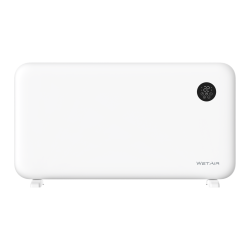
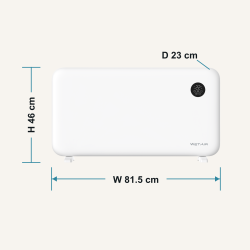
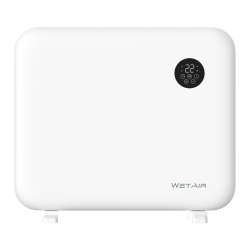
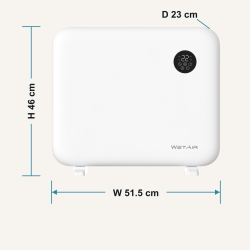
WetAir manuals and support
Check the exact model requirements
If the convector runs continuously and never reaches the set temperature, check the sizing in the room-size guide or contact WetAir service.
Sources and verification
Power ratings, ECO, open-window and frost-protection figures come from the WCH-H series manual. Cost examples are illustrative; actual consumption depends on the room and the tariff.
Frequently asked questions
Does a heater draw 2000 W all the time?
No. That is the maximum while heating. With a thermostat the element switches off once the set temperature is reached, so average consumption is lower.
Does ECO mode save energy?
Yes, once the room is warm: half power holds the temperature more evenly. ECO heats a cold room more slowly.
How many kWh a day does a convector use?
Multiply the power by the real heating hours. For a first estimate in an insulated room take a third to a half of the running time; the meter gives the exact figure.