

Heater formats
Convector or oil-filled radiator: which to choose
Both formats heat a room, but differently: a convector moves air quickly, an oil-filled radiator releases heat for longer.
Updated:
The short answer
Choose a convector when you need fast heating, a slim body, wall mounting or use in a bathroom. An oil-filled radiator suits places where gentle, lasting heat without air movement matters more — next to a bed or a desk. In both cases match the power to the room and check the manual's socket and clearance requirements.
How a convector heats
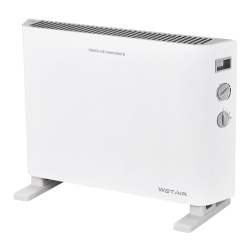
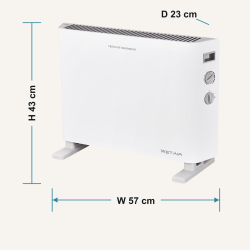
The heating element warms air that rises through the top grilles while cold air enters from below, so the room feels warmer within minutes. WCH-600EWW offers three power levels up to 2000 W and an adjustable thermostat and stands on the floor; the WCH-H series adds wall mounting, a half-power ECO mode and a weekly schedule.
How an oil-filled radiator heats
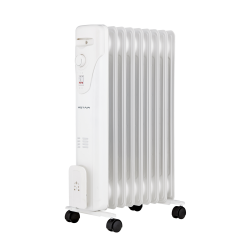
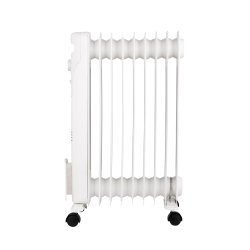
The fins are filled with mineral oil warmed by a heating element. The body warms up more slowly but keeps releasing heat after switching off, and the air does not move, so less dust is stirred up. WOH-9Y has a maximum output of 2000 W, a thermostat and tip-over shut-off; its room guide is up to 25 m².
Speed and feel of the heat
A convector is for rooms that must warm up quickly or hold a set temperature precisely. A radiator gives steadier warmth close to itself, which suits a fixed spot — beside a bed or a desk.
Space, mounting and safety
A convector is slim and can hang on a wall; the WCH-H series is rated IP24 and may be installed in bathroom zone 2 under the wiring regulations, but needs an earthed supply (class I). An oil-filled radiator is heavier, stands on the floor and has a hot body, so it needs clear space around it and attention when children are at home.
Running costs
At the same power rating both appliances draw the same current; the difference is how long they run. A thermostat and ECO mode stop the heater from working more than needed — see the guide on heating costs.
Format checklist
- Decide what matters more: fast heating or long, even warmth.
- Check the floor area and ceiling height against the model's guide figure.
- Decide where the heater will live: on the floor, on a wall, in a bathroom.
- Check the socket: no extension leads, earthed for class I appliances.
- Compare the controls: thermostat, power levels, timer or weekly schedule.
Common mistakes
- Buying an oil-filled radiator to warm a cold room quickly.
- Wall-mounting a convector without the clearances from the manual.
- Drying clothes or towels on the heater body.
- Plugging a heater into an extension lead together with other high-power appliances.
Models to compare
WetAir manuals and support
Check the exact model requirements
If you are unsure about the wiring or a bathroom installation, ask a qualified electrician and follow the model's manual.
Sources and verification
Specifications come from the WetAir manuals and product cards; the comparison is guidance, not a guarantee of the result in a particular room.
Frequently asked questions
Which is cheaper to run, a convector or an oil-filled radiator?
At the same power rating the consumption is the same. Savings come from the thermostat and ECO mode, which stop heating once the set temperature is reached.
Which is quieter?
Both formats work without a fan, so either suits a bedroom; only the thermostat clicks are audible.
Can an oil-filled radiator be wall-mounted?
No, WetAir oil-filled radiators are floor-standing. Wall mounting is provided on WCH-H series convectors.